Aston Villa Analyst Victor Manas Receives Four-Match Stadium Ban After Man Utd Draw
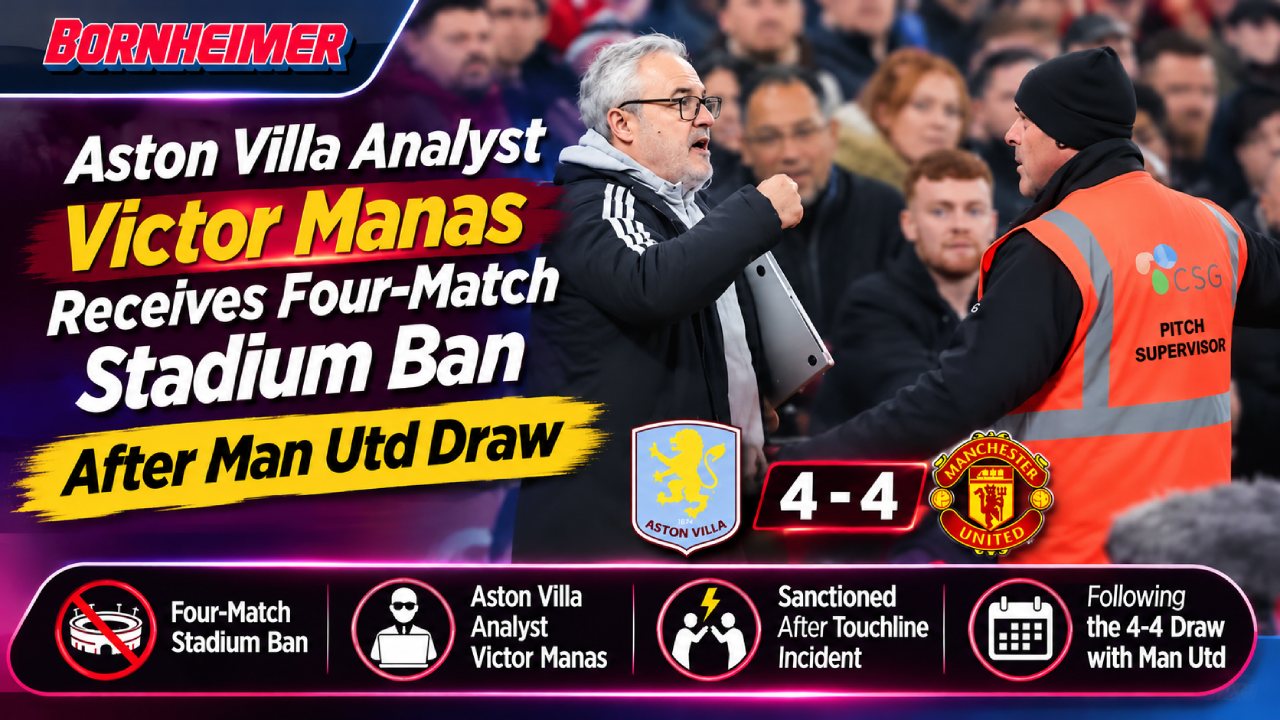
Bornheimer – Aston Villa analyst Victor Manas has received a four-match stadium ban and a £6,000 fine following the club’s 4–4 Premier League draw with Manchester United. The Football Association announced the sanctions on 26 November 2026, after Manas admitted two misconduct charges. An independent Regulatory Commission also warned him about his future conduct. The charges concerned his behaviour towards match officials at Old Trafford on 8 November. The first incident occurred near the tunnel at half-time. The second came around the 96th minute, when United scored a disputed equaliser. The four-match stadium ban applies to Manas, a longstanding member of Unai Emery’s backroom staff.
The first incident took place near the tunnel at half-time
The first charge concerned improper conduct towards match officials around the tunnel as the teams went in at half-time. That timing matters because the dispute most closely associated with the case happened much later. By the time Patrick Dorgu scored in stoppage time, the conduct covered by the first charge had already taken place. The FA’s announcement identified where and when the incident occurred. However, it gave no detailed account of the exchange. Manas later admitted the charge. The commission’s written reasons were due to follow, leaving the initial announcement as a summary of the charge and the sanction imposed after the hearing.
United turned a 4–2 deficit into a draw in stoppage time
Villa entered stoppage time with a 4–2 lead and looked set to take three points from Old Trafford. Joshua Zirkzee cut the deficit before Patrick Dorgu headed in from a corner in the 96th minute. The two late goals turned what had looked like a Villa victory into a 4–4 draw. For Emery’s team, the second goal was particularly frustrating because the visitors believed their goalkeeper had been fouled. The sequence explains why emotions were high in the closing moments. It also puts the second misconduct charge in context. The officials had just allowed the equaliser to stand when Manas reacted.
Villa believed Dorgu had fouled Zion Suzuki
Villa’s objection centred on contact involving Dorgu and goalkeeper Zion Suzuki before the equaliser. The visitors believed the goal should have been disallowed for a foul. Emery later spoke about the physical pressure Suzuki faced at the corner and how difficult it was to concede twice so late. That was Villa’s account of the incident. Dorgu’s goal stood, and the match ended 4–4. For anyone following the disciplinary case, the distinction is useful. The disputed corner explains what prompted the late protests. The commission dealt with Manas’s conduct towards the officials during the match.
The second charge concerned Manas’s reaction in the 96th minute
The FA’s second charge concerned improper conduct towards match officials around the 96th minute. The timing placed it alongside the argument over United’s equaliser. A United steward escorted Manas from the stands after his reaction. He subsequently admitted the late charge as well as the one relating to half-time. Together, the admissions establish the scope of the case more clearly than the footage or discussion of the corner alone. The incident near the tunnel and the one late in the match happened in different places and at different stages. Both were before the independent commission when it considered the sanction.
Also Read : Viral Seoul Scarf Seller Turns Harsh Humor Into a Tourist Attraction
The independent commission imposed three sanctions
Following a hearing, the commission imposed the stadium ban, the fine and a warning about Manas’s future conduct. Each has a practical consequence. The ban affects where he can carry out his duties on matchdays, the fine imposes a financial penalty, and the warning addresses his behaviour going forward. The initial statement confirmed the outcome but gave few details about how the commission reached it. Its written reasons are the place to look for that explanation. In particular, they may clarify what weight the panel gave to the two admitted charges and any other factors it considered when setting the penalty.
Manas has faced disciplinary action before
Manas previously received a three-match ban in 2023 following an altercation with Arsenal coach Miguel Molina. In 2025, he was suspended for two matches for his part in a confrontation during Villa’s 3–0 defeat at Newcastle United. The four-match stadium ban is longer than either of those sanctions. That history provides context for readers who remember the earlier incidents. However, the length of the previous bans cannot explain on its own how the commission decided this case. The immediate facts are that Manas admitted two charges arising from the same fixture and that the commission issued a warning alongside the ban and fine.
Villa must adjust how it handles matchday analysis
For Villa, the immediate issue is how to cover Manas’s stadium-based duties during the four affected matches. Analysts help coaching staff make sense of what is happening during a game, when decisions often have to be made before the next break in play. A different member of staff may need to take on some of that work, depending on how Emery organises his team. The football result is already settled, with United and Villa sharing the points after two stoppage-time goals. Attention now turns to the commission’s written reasons and what they reveal about its assessment of the two incidents.